
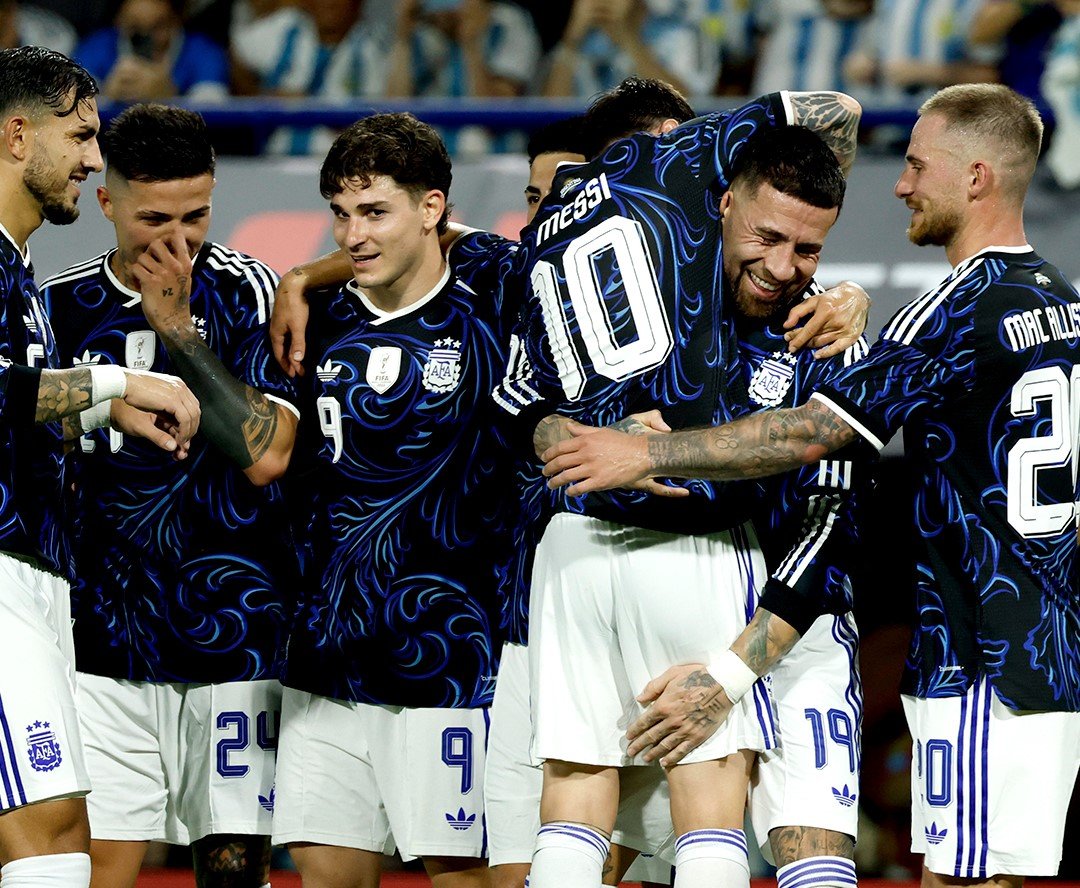
The defending champions are clear favourites to win World Cup Group J, but Lionel Messi and co will be facing sides with disruptive potential.
Argentina
The world champions travel to North America seeking to defend the title they won in Qatar four years ago, a triumph that largely centred around the narrative of Lionel Messi, who after many years and near misses, eventually matched the achievement of country great, Diego Maradona.
But over the past five years, Argentina have moved from a team on the periphery to become one of the footballing powers of the world. They are the dominant force in South America, winning the last two editions of the Copa America to go with their World Cup success. In the South American qualifiers, they finished nine points clear of second-placed Ecuador to ink their names on the World Cup invite list without much trouble.
Coach Lionel Scaloni works with a technically gifted midfield led by Alexis Mac Allister and Enzo Fernandez. There is Rodrigo De Paul able to do the hard running, and when Messi plays, the attack flows through him, the football great able to still create high quality chances in the final third with his sublime passing.
The team is full of quality and complete. Julian Alvarez has had a mixed season but remains one of the most talented forward players around. Lautaro Martinez, Giuliano Simeone, Thiago Almada and Nico Gonzalez are all high-quality options capable of delivering a World Cup trophy. Nico Paz is one of the most talented youngsters in the game and even he is not guaranteed a start.
Algeria
This will be Algeria’s fifth World Cup appearance but only their first in 12 years. They had a standout performance in 2014 when they reached the last 16 and pushed eventual champions Germany close before losing in extra time. Since then they have not made it to the tournament.
They had a dominant spell on the African continent for a time but even those days seem to have passed. On a mission of resurgence, Algeria secured qualification by recovering from an early defeat against Guinea. They won six of their remaining seven qualifying matches and eventually confirmed top spot in Africa’ Group G with a comfortable victory over Somalia.
Their attack is built around former Manchester City star Riyad Mahrez, who is in the twilight of his career but can still offer creativity, leadership and experience. This will be his last World Cup and he will aiming to make an impact. There is also Wolfsburg’s Mohamed Amoura, who finished as one of the top scorers in African qualifying and could be one of the breakout stars of the tournament. An interesting addition to the squad is goalkeeper Luca Zidane, son of former France great Zinedine Zidane. Having represented France at youth level, he has switched allegiance to Algeria and could feature prominently at the World Cup.
Austria
Austria’s route to qualification was less straightforward than it initially appeared. Five consecutive wins put them in command of their group before late defeats created unnecessary tension. They eventually secured qualification on the final matchday thanks to Michael Gregoritsch’s decisive goal against Bosnia and Herzegovina.
This is Austria’s first World Cup appearance since 1998. Historically, they were a good side, notably finishing third in 1954 and reaching the second group stage in both 1978 and 1982. They fell behind at the turn of the century but have now seen their fortunes transformed under Ralf Rangnick, who left Manchester United to take charge of the country’s national team.
Rangnick has implemented his high-pressing and transition football with Austria and they performed brilliantly as recently as Euro 2024, where they topped a group containing France and the Netherlands before losing to Turkey in the last 16.
The task in this tournament will be to go as deep as they can into the knockout stages. Marcel Sabitzer is a power in midfield but the talented Christoph Baumgartner has high technical ability and will likely play a key role for Austria.
Jordan
Jordan are one of the smaller footballing nations benefitting from the expanded 48-team World Cup. This will be their first World Cup having come close in the past but never quite making it. They reached the intercontinental play-off for the 2014 World Cup but were easily beaten by Uruguay. This time they needed no play-off and secured their place with a match to spare.
There is no standout talent in the side and much of their work will have to focus on collective discipline to stay compact and hope to play on the break, but a side who reached the Asian Cup final in 2024, before losing 3-1 to Qatar, have showed that at least they can do enough to frustrate other teams, even if making it out of the group stage here is unlikely.