
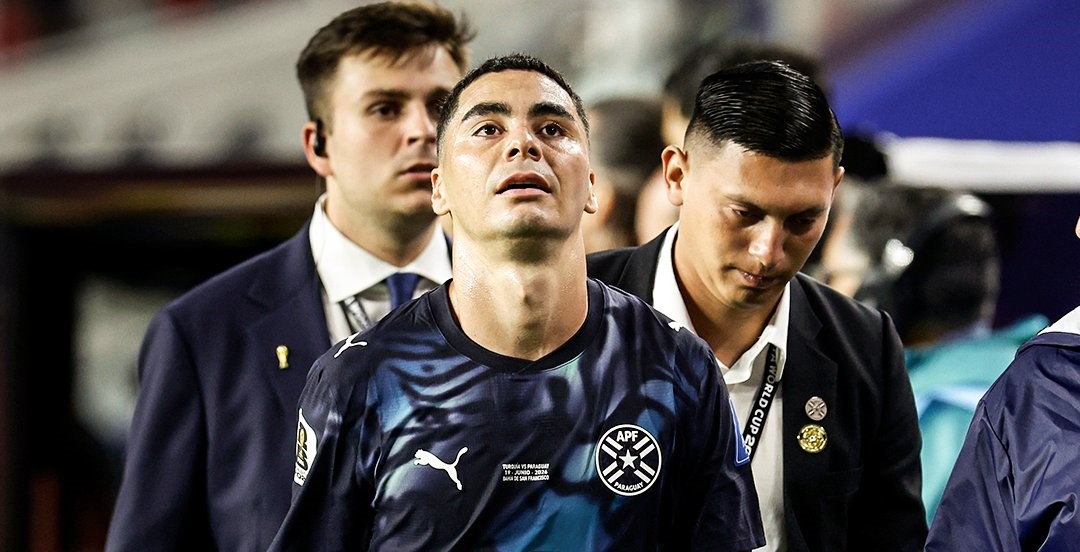
Two players at the World Cup have already been penalised, but the law won’t apply in club competitions next season
Uefa has decided not to introduce automatic red cards for players who cover their mouths while speaking to opponents in its club competitions next season.
Instead, the European footballing governing body intends to treat the act as unsportsmanlike conduct that may or may not result in a yellow card.
The rule was adopted by Fifa ahead of this 2026 World Cup, where it was implemented for the very first time against Paraguay’s Miguel Almiron.
But Uefa’s decision means the rule will not be used in the Champions League, Europa League or Conference League. Uefa confirmed the position in a statement on Thursday as it announced a series of law changes for the 2026-27 season.
A Uefa statement said referees may instead caution players who cover their mouths to conceal communication during an exchange with an opponent.
“This is obviously without prejudice to any disciplinary investigation or proceedings that may follow as a consequence of or in connection with such behaviour,” the statement added.
Fifa introduced the sanction to send players off for deliberately hiding what they say during confrontations with opponents. Besides Almiron, Ecuador defender Piero Hincapie has also been shown a red card for the offence.
England midfielder Jude Bellingham avoided the punishment during his side’s match against Ghana after match officials judged that he had not covered his mouth “in a confrontational manner”.
But why are Uefa rejecting the rule? It was introduced in the first place because of a case that occurred during a Uefa game, the Champions League play-off match between Real Madrid and Benfica, when Benfica’s Gianluca Prestianni covered his mouth with his shirt while speaking to Madrid’s Vinicius Junior.
Vinicius alleged that Prestianni had racially abused him, but since the player had his mouth covered there was simply no way to determine what he said and punish him appropriately.
A subsequent Uefa investigation found Prestianni guilty of homophobic conduct (after he claimed during a hearing that what he had uttered was a homophobic, not a racial, slur) and handed him a six-match suspension.
It would seem that Uefa has examined the contentious nature of the rule so far at the World Cup and decided not to apply it. Red cards were given to Almiron and Hincapie, but not to Bellingham.
In a high-profile European game, a decision to send a player off could have serious repercussions, so a lot of outrage is likely to follow the decisions. Uefa has apparently decided not to open that can of worms.
The governing body has also decided not to adopt Fifa’s option of issuing red cards to players who leave the field in protest. However, it will introduce the expanded use of VAR to review wrongly awarded corner kicks.