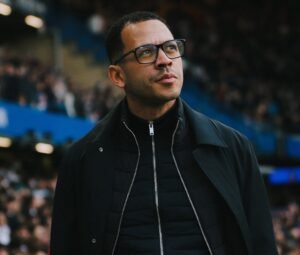

November marks a full year since the Portuguese was hired at Old Trafford
Ruben Amorim says his first year at Manchester United has shown him he can hold onto his beliefs in the midst of intense pressure.
November will mark a full year since Amorim was appointed as United manager. The Portuguese endured a difficult start to life in England but has overseen some improvement in recent weeks. United’s 4-2 win over Brighton last weekend made it three consecutive league victories for the first time under his tenure.
The Red Devils also inflicted a defeat on rivals Liverpool at Anfield, marking the first time they had won at the home ground of their rivals in 10 years.
Before the victories raised confidence in the Portuguese’s approach, he was heavily criticised for his inflexible 3-4-3 system that pundits said was making his team worse and could never work at United.
“It was a journey, a big journey,” said Amorim in reference to his first year. “It was really tough. Good moments, bad moments. I learned a lot – that is really important.
“I learned that even in my lower moments I can stick with the things I believe, and that is a good thing for anyone to understand. It’s one of the biggest honours of my life to be here and I want to continue here for many years.”
Amorim’s record since replacing Erik ten Hag last November stands at 21 wins and 19 defeats from 52 matches – a mixed return that shows just how turbulent his first year has been.
United are targeting a fourth successive win under the Portuguese in Saturday’s match against Nottingham Forest at the City Ground.
The fixture will see Amorim come up against new Forest manager Sean Dyche, who earlier this year suggested he could have won more games than Amorim with the United squad if he played his favoured 4-4-2 system.
“Maybe it is true that if we played in a 4-4-2 we’d have won more games,” Amorim said. “But I have a way of playing that is going to take a while, and then in the future it is going to be better.
United’s coach pointed out that Dyche’s perspective as a pundit would naturally be different than as a coach.
“I can look at Sean Dyche as a manager and then as a pundit,” Amorim said. “If you are a pundit and you don’t say very strong things, I don’t want to watch you. So I can understand that it’s a completely different job.
“I know Sean Dyche is smart and he knows how to play the game. He understands that it is one thing seeing the game and talking about it. It is another thing to coach a team.”