
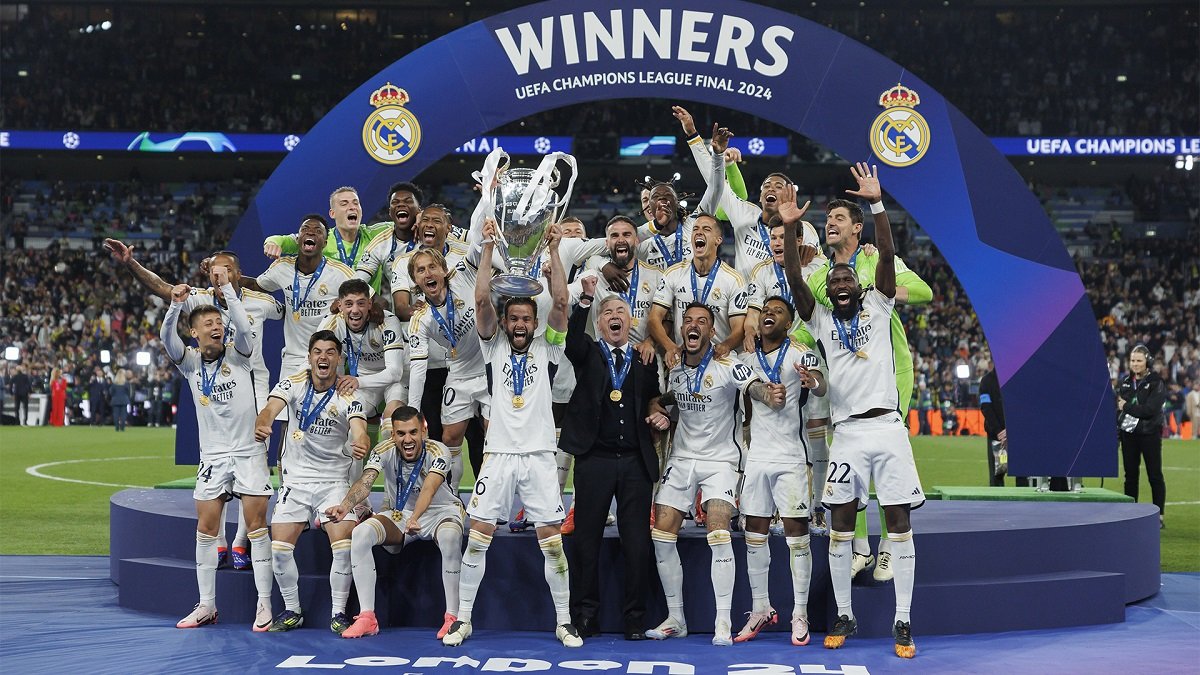
The idea that Los Blancos have an irresistible Champions League destiny should be greeted with derision
Much has been said about Real Madrid in the Champions League, and how the all-white outfit imbues on its wearers the spirit to come alive and dominate Europe’s elite competition.
Well, that’s not true at all. The idea of Madrid’s Champions League DNA is fake. It doesn’t exist. Yes, the Spanish giants are no doubt a European superpower, but they are just one of several. Their record in the competition is all just a big helping of luck.
Madrid have won the Champions League 15 times, but that never would have been the case if not for how the competition itself started. Madrid were one of the first teams to begin playing in the European Cup, as it was known at the time. They won the inaugural edition in 1955-56 and followed that up with four more victories.
But this was not particularly unusual, especially in those times. Only four years later, Inter Milan would win it twice, and from ‘71 to ‘73 Ajax would win it three times in a row, just two less than Madrid had managed. From ‘74 to ‘76 Bayern Munich would also snap up the trophy three consecutive times.
Liverpool would win three times between ‘77 and ’81, and in-between, Nottingham Forest won twice in a row in ’79 and ’80.
Los Blancos had first movers’ advantage, snatching up to five victories before the competition increased in prominence and status, and therefore in the vigour with which teams competed.
The European Cup had not yet attained the sort of reverence it later would in the 21st century. In fact, in the maiden edition the English football league pressured Chelsea into declining the invitation to participate, on the basis that it would distract them from domestic football.
Manchester United would become the first English team to participate the next year only by stubbornly rejecting the advice of the FA.
But after the opening decade Madrid would not win the trophy again until ‘98, a period of over 30 years. What team with a Champions League DNA fails to win it in as long as 30 years?
The period between 2014 and 2024 when Madrid won the trophy six times has been used as evidence of Madrid’s irresistible Champions League destiny. But that argument has had the life wrung out of it.
First of all, the only notable thing should be that Barcelona did not win more in this period. This was a time when Spanish football began to dominate in Europe, and that is because they stepped into a vacuum created in a decade when the other strong leagues of Europe grew weak. Inter Milan and AC Milan – and with them the strength of Italian football on the European stage – declined badly.
Manchester United lost their powers after Sir Alex Ferguson and David Gill both left the club. Liverpool were still in a perpetual state of dormancy. The finals in 2005 and 2007 were small patches of joy in an atmosphere of gloom that did not begin to lift until around 2017, when Jurgen Klopp had started to settle in at the club.
Chelsea won the Champions League in 2012 but they were newcomers to major success. Manchester City had begun to dominate in the Premier League but they were not yet a great power in Europe, still lacking their first European silverware. And in the biggest Champions League games, they played with all the tension that came with that lowly status.
This all meant that English teams were too weak to compete effectively in Europe. The strength of the Dutch league had long faded away. A French team had won just once, Marseille in ‘93.
The only real contestants were perhaps Bayern Munich, and even they had a tendency to collapse in Europe.
This all provided the perfect platform for Spain to dominate. Barcelona and Atletico Madrid also had their moments in this period, the latter notably reaching two finals. It is not a coincidence that two of Madrid’s trophies were won defeating their local rivals.
Madrid have had impressive late wins in the knockout stages of the Champions League, but this is just the product of a team with an impressive array of attacking talent.
Teams with an attacking mentality always retain the ability to turn things around on the biggest stage, and Madrid are hardly the only side to have done so. Liverpool turned around a 3-0 lead to win the Champions League in Istanbul in 2005. Manchester United scored twice in stoppage time to come from behind and win the trophy in 1999 against Bayern Munich.
So when anyone mentions Real Madrid’s Champions League DNA to you, roll your eyes in derision and walk away.