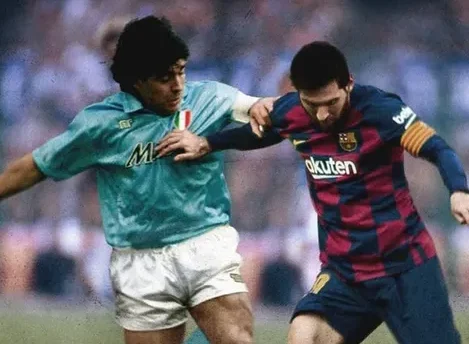
Maradona was a genius but it is difficult to claim he stands up to Messi in any GOAT debate
While interviewing Cristiano Ronaldo, famous media personality Piers Morgan said the Portuguese and not Lionel Messi was the Greatest of All Time.
Strikingly, Morgan went ahead to say that Messi was not even the GOAT of Argentina, that the title should go to Maradona. A lot has been said on the GOAT debate in football, but this one is particularly interesting.
Most people would have assumed that the Messi vs Maradona debate ended in Lusail, Qatar in 2022, when Messi led Argentina to World Cup triumph, ending a 36-year drought and repeating the feat Albiceleste achieved in 1986, when they were led by Maradona himself.
If there are any remaining who still believe, somehow, that Maradona was better than Messi and deserves the GOAT crown, whether in Argentina or worldwide, it is time to drop that idea.
Here’s why. First, any football legends comparison must pay attention to the eras in which they played. Messi did not play the same version of football Maradona played. In Maradona’s time, football still had a strong working-class identity and professionals were not at the level they are in today’s game.
Sports science was minimal. Training was less systematic and structured. Fitness culture was weaker. Today, teams use data and hours of footage to analyse every inch of a club’s system and a player’s style of play, in order to figure out how to stop them.
Football was far more tactical in the 2000s and 2010s than it was in the 1980s. Defensive shapes became much better, more compact and more technical. Each manager picked the style of the old greats and improved on it.
Pick a video, any video, of the football played in the ’80s and ’90s and watch how poorly set up the defenders could be at times, even in the so-called elite teams. Any fan today would be raging.
There is the argument that Messi had players like Xavi, Iniesta and Busquets, while Maradona did things alone. Which is ridiculous. First of all, Messi was Barcelona’s best player by a country mile, and his presence in the Barcelona team gave everyone a lift.
He drew the attention of the opposing team, who were always deathly terrified of what he could do in the attacking third. It relieved the midfield and allowed them to impose themselves better in the game. Without Messi all versions of the Barcelona team were mortal and beatable.
Also, Maradona had a lot of quality players in Napoli. That was the decade that the club were gradually rebuilding the team, as evidenced by their ambition to shell out a then world-record €12m fee to sign Maradona from Barcelona. What kind of club with average players would do such a thing?
As you’re reading this article right now, go back 20 years and pick out when an average club with mediocre players broke the world transfer record.
The season Maradona arrived in Napoli, in 1984-85, Hellas Verona won the Scudetto. They had only been promoted from Serie B two seasons before, in 1982-83. So, the possibility was there to build a strong team and Napoli were not unique. They were hardly a unicorn.
Ascribing all of their achievements in that decade simply to the arrival of Maradona is reductionist and unacceptable. It neglects the work the club did in the background to build a strong team that could compete for trophies in an opportune period in Italian football.
In moulding the team, the club had the likes of Ciro Ferrara, a prodigy acclaimed as one of Italy’s finest and one of the best centre-backs of his generation. There was “The Warrior” Salvatore Bagni, a ruthless destroyer in midfield.
In attack alongside Maradona there were Bruno Giordano and Careca. At a point, the trio were nicknamed the magical frontline, from their names: Ma-Gi-Ca.
Giordano had previously been Serie A’s top goalscorer of the season with Lazio before joining Napoli a year after they brought in Maradona. When they won the Copa Italia in 1987 it was he and not Maradona who finished as top scorer of the competition.
Careca was a Brazilian prodigy who scored 73 goals for Napoli, eight fewer than Maradona, having played 24 games less than the Argentinian.
So the idea that Maradona “did it alone” in Napoli is ridiculous. That’s an idea built up around a cult of personality but doesn’t actually exist. It is more the romantic fiction built around the man than actual reality. It is more correct to say that his teammates were not as publicised as he was, which is only natural given the period in question.
Even Xavi, Iniesta and Busquets occasionally went unnoticed and would have been even more so if they had played in an era without the Internet.
Also, Messi secured his achievements in a tough league, same as Maradona. When Messi emerged in the late 2000s the Spanish league had become the strongest in the world. Between 2008 and 2018, seven out of the 10 Champions League winners were Spanish. The likes of Atletico Madrid, Espanyol and Sevilla were the teams to beat in the Europa League.
But Messi still dominated. He won eight Ballon d’Or awards and completely changed what it means to be a playmaker and a goalscorer. He has 894 career goals and still counting, more than double the 348 that Maradona could muster.
People also forget that Maradona played in the same club Messi did. He had the same opportunity at Barcelona but struggled to achieve anything. They won three trophies in is two seasons but these were cups. They couldn’t win the league.
After getting extremely frustrated at the club he started an infamous fight on the football pitch during a cup final against Athletic Bilbao, which Barcelona lost. After breaking down and quarrelling with a lot of people, including club executives, he was forced to leave Barcelona. Indeed, the club won the league the following season without him.
If there is any metric in which people could have an actual argument that Maradona surpasses Messi, it is perhaps in Maradona’s well-publicised fighting spirit. But Messi was never in the situation where that was necessary.
In fact, most people would rather sit and marvel at Messi’s genius than quarrel with or insult him, which Maradona claimed was the reason he broke down at the club. If anyone thinks insults no longer exist in modern football, they should consider the case of Vinicius Junior, who has been subjected to excessive abuse.
Messi had his low moments. In 2016 when Argentina lost the Copa America final, for example, he was at his nadir. He retired from the national team and gave up completely. But then he came back, with a beard and a renewed determination to become a champion with Albiceleste, and six years later in Qatar, he had the World Cup in his hands and the world at his feet.
When he has faced challenges, the Greatest of All Time, the GOAT, has conquered them. But most of the time he didn’t need to fight, because his sheer brilliance was just more than enough to pave the way.