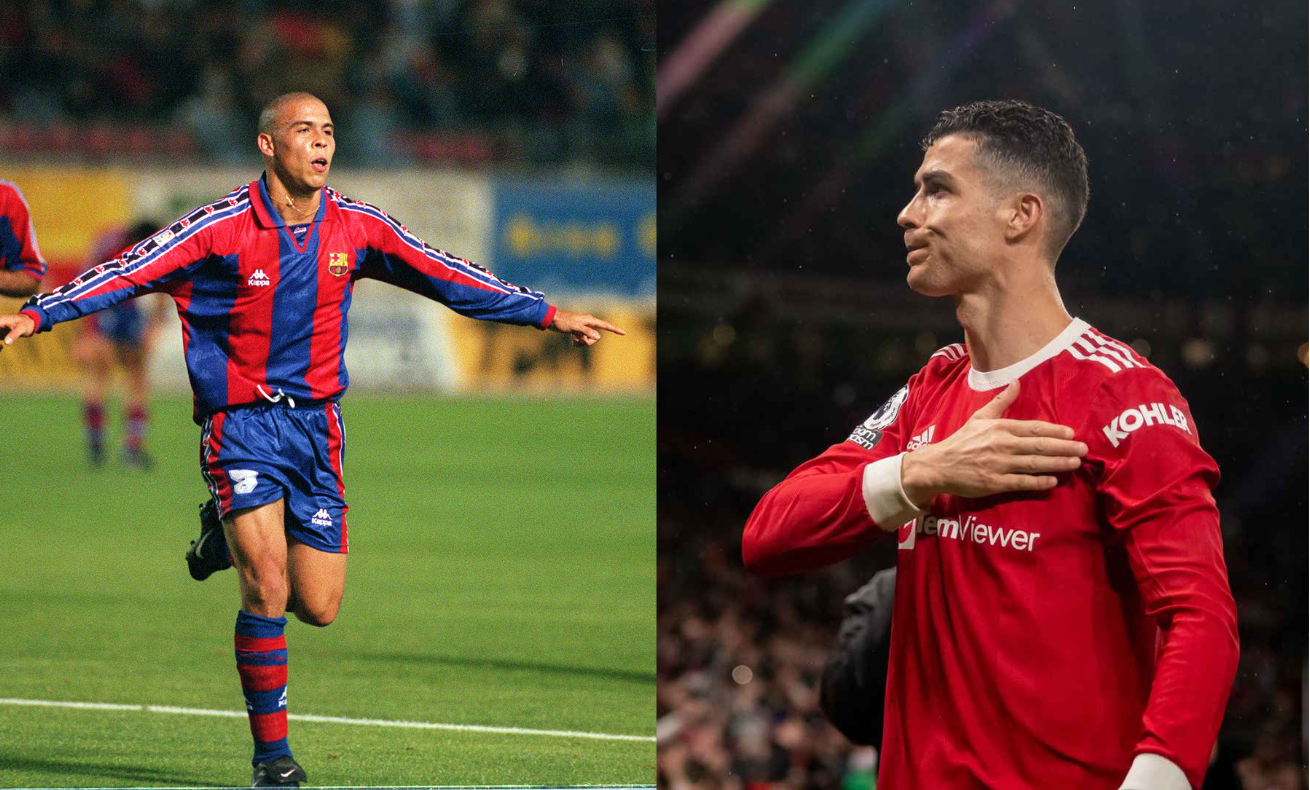
While R9 was indeed one of the greatest to ever play the game and influenced many modern strikers, ultimately he must bow to the irresistible force that is Cr7
The question of which of these two greats deserves the “real Ronaldo” title might be little more than naming convention. Given the form of Portuguese names, the surnames tend to be dropped and the first name retained almost as a mononym.
R9’s (Ronaldo Luís Nazário de Lima) first given name is Ronaldo, while Cr7’s (Cristiano Ronaldo dos Santos Aveiro) is Cristiano.
If we are sticking with that, then by all means let us call one Ronaldo and the other Cristiano.
But in terms of performance, while R9 was indeed one of the greatest to ever play the game and influenced many modern strikers, ultimately he must bow to the irresistible force that is Cr7.
Nazario scored 385 goals in a career that spanned 18 years, although he sadly missed nearly three years through worrying knee injuries. Nicknamed O Fenômeno (The Phenomenon), he represented what was the prototype of the modern elite striker. A handful a player, with a bulldozing footballing style, dropping deep to collect the ball and then running at defenders to terrorise them; or otherwise running onto passes through defence lines to convert with a magical touch.
Nazario of course was the epitome of the Brazilian Jogo Bonito, the beautiful game, designed to entertain, mesmerise and bedazzle. R9 had starring performances at the 1998 and 2002 Fifa World Cups that saw him win the prestigious tournament for the second and third times respectively, having won it for the first time in 1994 as a 17-year-old and the youngest member of the squad.
He also won the Fifa Player of the Year award in 1996 and 1997, back when that prize still counted something, before being completely overshadowed by the Ballon d’Or. And he remains to date the youngest player to win the Ballon d’Or itself, at 21 in 1997.
These accomplishments are immense but they have clearly been surpassed. Cristiano Ronaldo joined Manchester United as an explosive teenager who was all about mesmerising defenders with fancy feet, somewhat in the style of the jogo bonito. His stepovers became famous not only for the typical outward but also the unique inward motion.
But Ronaldo moved with the times. Football was changing and at United in 2007, under the keen gaze of an Old Trafford faithful hungry for goals, for winning, he went through a metamorphosis and was reborn into a being of pure goals.
After that baptism Ronaldo would change form again – notably moving from the wings to become a monster that torments the penalty area – but he never lost that essence of being a goal machine.
Ronaldo has now scored over 950 career goals, far exceeding the comparatively paltry 385 produced by Nazario, even if you adjust for the latter’s injury-hit years. To put it in perspective, Ronaldo has scored over 500 career goals more than Nazario could manage.
When Nazario enjoyed a famous and glorious season for Barcelona in 1996-97 he scored 47 goals in 51 games, an outrageous output at the time, but in the 2010s that end-product was to be trivialised by the godly numbers that Cr7 and his eternal rival Lionel Messi were putting out.
Nazario, for all his brilliance, is not even the highest goalscorer for Brazil. He is the third highest (62), behind Neymar (79) and Pele (77). Meanwhile, Ronaldo has produced an astonishing 141 for Portugal, twice more than Nazario was able to muster.
But Ronaldo’s legend goes far beyond that. His sui and ‘at rest’ (where he places two hands on his chest, eyes closed) celebrations have been copied everywhere from players scoring in obscure local leagues to people posing for university graduation photographs.
In the all-time rankings Cr7 has to be lifted above Nazario to take his throne at the very top of football.
In the end Nazario lost his grip on footballing power, described famously – or infamously – by Sir Alex Ferguson as the “fat one” and the “old one”. But Ronaldo, the Ronaldo, has held onto his abilities right to the very end, long after his 40th birthday, a thing to be given up at the right age rather than lost.